
November 16, 2026
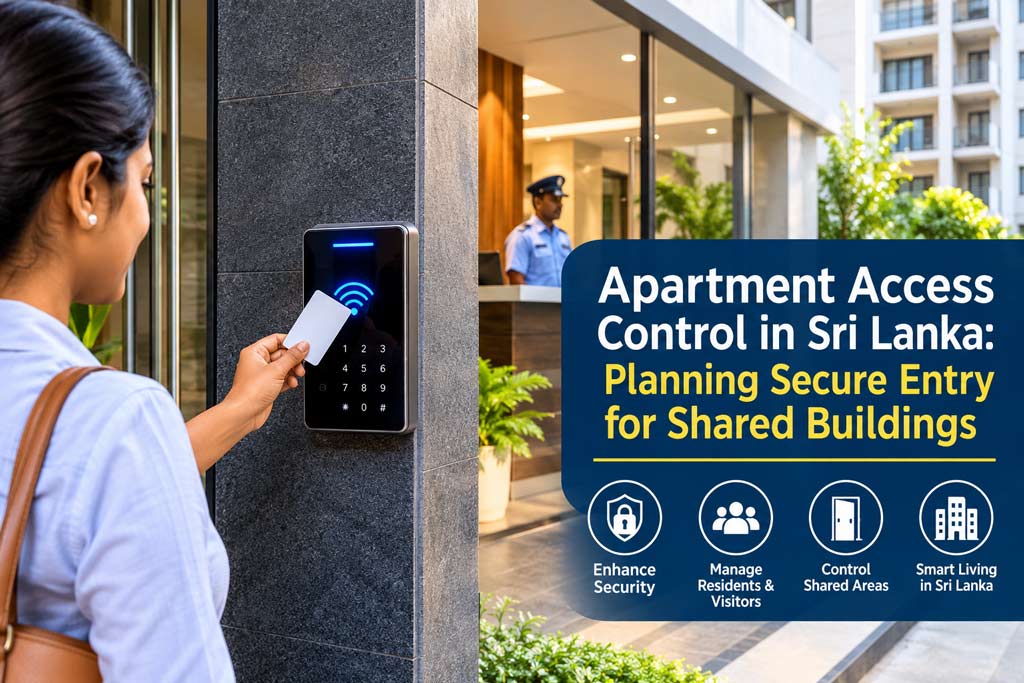
Apartment Access Control in Sri Lanka: Planning Secure Entry for Shared Buildings
Apartment Access Control in Sri Lanka: Planning Secure Entry for Shared Buildings
An apartment building has more than one entrance to consider. Residents may use a main entrance, a vehicle gate, a lobby door, a lift area and other shared spaces.
Managing access to these areas can become difficult when a building relies only on conventional keys or informal arrangements.
An apartment access control system provides a way to organise who can enter selected areas and how permissions are managed. The correct design depends on the building layout, resident requirements, security arrangements and available infrastructure.
This guide explains what apartment owners, developers and management committees should consider when planning access control in Sri Lanka.
Why apartment buildings need an access plan
In a residential house, access may be managed by one family. In an apartment complex, many households share common facilities.
The building may also have security officers, cleaners, maintenance technicians, delivery personnel and property-management staff.
A planned access system can help management organise these different requirements. However, installing electronic readers alone does not create a complete security policy. The building also needs clear rules for issuing, changing and removing access permissions.
Which doors should be controlled?
Start by reviewing the building and identifying the areas where controlled entry may be useful.
Typical locations include:
-
Main pedestrian entrance
-
Lobby or reception entrance
-
Parking entrance
-
Staircase doors
-
Selected service or restricted areas
-
Staff-only rooms
-
Shared recreational facilities
Not every door needs electronic access control. Some doors may need to remain freely accessible for safety, emergency evacuation or building regulations.
The design should be reviewed with the relevant building professionals and authorities before installation.
Common access methods
Different technologies can be used depending on the door, expected traffic and building requirements.
RFID cards or tags
Residents and authorised staff can use compatible cards or tags at a reader.
This can be useful where many people need access and the building wants a managed way to issue or replace credentials.
PIN code access
A keypad can allow entry using a code. Management must decide how codes are issued, shared and changed.
A single permanent code shared by every resident may be difficult to manage when occupants change.
Mobile-based access
Some systems support access through a mobile phone using Bluetooth, an application or an online service.
Check the system’s connectivity requirements and what happens if a resident’s phone is unavailable.
Fingerprint access
Some readers support biometric identification. Before choosing this option, consider resident acceptance, privacy, enrolment procedures and how the system handles people who cannot conveniently use the reader.
The available methods and their capabilities depend on the selected hardware and software.
Managing residents, visitors and service staff
A good access plan should define how each group enters the building.
Residents: Each household should receive the appropriate access permissions under the building’s policy.
Visitors: Decide whether visitors are admitted through a security desk, intercom, resident authorisation or another approved procedure.
Delivery personnel: Establish a consistent process that does not require permanent access to residential areas.
Cleaning and maintenance staff: Provide access only to the locations and times needed for their duties, where the system supports these controls.
Former residents and staff: Create a process for cancelling or changing access when someone moves out or no longer works at the property.
The principle of giving people only the access they need is commonly known as least privilege. It is a useful foundation for planning access permissions.
Planning installation and maintenance
Before choosing a supplier, prepare a basic site assessment.
1. Identify the doors and entry points
Prepare a floor plan showing the main entrance, parking gate, shared doors and restricted areas.
2. Check the existing infrastructure
The installer and building management should review the door construction, locking hardware, power availability, cable routes and network requirements.
3. Confirm emergency arrangements
Access-control equipment must not interfere with safe evacuation or emergency access. Confirm the required fail-safe or fail-secure behaviour for each door with the relevant professionals. These terms describe how a locking device behaves when power is lost; the correct choice depends on the door’s purpose and applicable safety requirements.
4. Decide how users will be managed
Agree who can issue credentials, approve new residents, remove former users and manage system administrators.
5. Plan ongoing support
Ask who will handle faults, credential changes, software administration and replacement parts.
6. Test the complete system
Before handover, test normal entry, authorised and unauthorised credentials, power-loss behaviour and the agreed emergency procedures.
Questions to ask an access-control supplier
Before approving a project, apartment management should ask:
-
How many doors can the proposed system manage?
-
Which credential types are supported?
-
Can access be assigned separately for residents, staff and visitors?
-
How are lost cards or removed users handled?
-
Does the system require a local computer, server or internet connection?
-
What happens during a power failure?
-
What emergency release arrangements are included?
-
What maintenance and technical support are available?
-
Are any door modifications or additional electrical works required?
Ask for the proposed system architecture and installation scope in writing. This helps avoid misunderstandings about what is included in the quotation.
Apartment access control in Sri Lanka
Apartment buildings in Colombo, Negombo, Kandy and other growing urban areas may have different access requirements. A small residential block may need only a controlled main entrance, while a larger development may require several access points and different user permissions.
A site inspection is important because the correct solution depends on the actual doors, traffic patterns and existing infrastructure.
Building owners and management committees researching electronic door locks and access-control solutions can review Smartlock.lk and discuss the requirements of their property with a suitable supplier.
Conclusion
Apartment access control should begin with a clear plan for doors, users, permissions, emergency arrangements and ongoing maintenance.
Choosing the correct technology is only one part of the project. A well-defined management process is equally important for maintaining organised access as residents and staff change.
Frequently asked questions
1. What is an apartment access control system?
It is a system that manages entry to selected building areas using credentials such as cards, PIN codes, mobile devices or other supported methods.
2. Can one access card open the main entrance and other shared doors?
Some systems can assign one credential to multiple authorised doors. This depends on the hardware, software and access permissions configured for the building.
3. Does apartment access control need an internet connection?
Not always. Some systems operate locally, while other functions may require a network, server or online service. Confirm the requirements before installation.
4. What happens if a resident loses an access card?
Building management should follow a procedure to report the lost credential and cancel or replace it if the system supports that function.
5. Should every apartment door have electronic access control?
Not necessarily. The decision should consider the purpose of each door, resident convenience, emergency access and applicable safety requirements.